 SMURF
SMURFSMURF, Rebuilt
The full story of what we've done since launch: the coin nobody meant to ship, the burn that had stalled, and the permanent engine we built to replace it.
01The Coin Nobody Meant to Launch
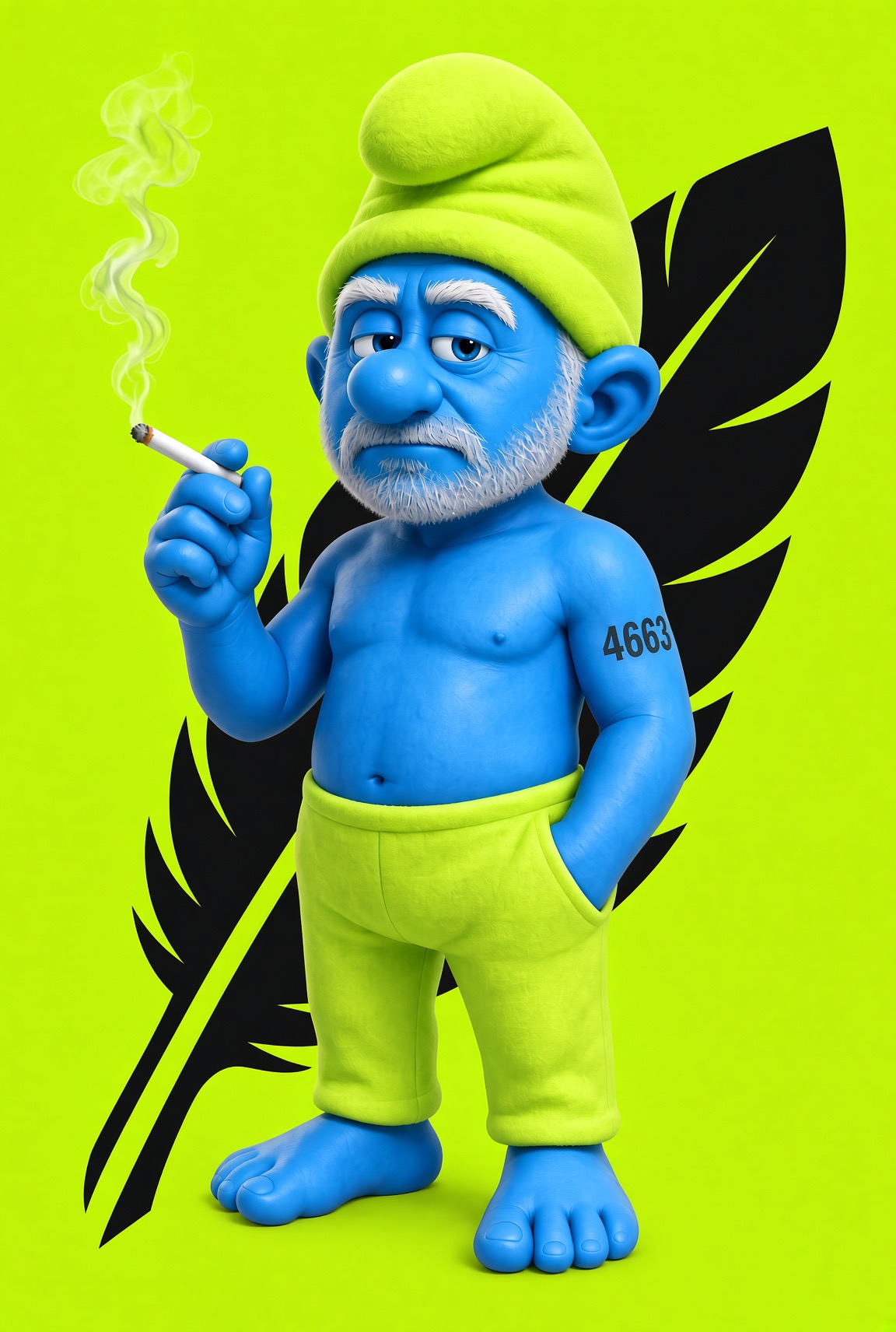
SMURF — "Smoke UR 4663" — was the first token with a hook ever deployed on Robinhood Chain, back in June. It shipped with a 41% burn wired into every trade, no owner and no mint, then got left for dead. Nobody ran it.
Here's the catch that made us pay attention: that 41% was so heavy it strangled trading, so in its entire life the "deflationary" token had burned less than 0.05% of supply — a burn coin that never actually burned. We found it, dug through the contracts to prove it was clean and moveable, and decided to make it work.
02Giving It a Community
First move was to hand it to the people who earned it. We airdropped 333,333,333 SMURF to 649 holders of SmokeV2, the predecessor community, weighted to the snapshot down to the last unit and screened so nothing leaked into pools or dead contracts.
Then, because the 41% vault choked every trade, we opened a real market pool with a saner split: a 7.77% fee, divided 3.33% burned, 3.33% to the treasury index, 1.11% to the team. For the first time SMURF could actually be bought and sold — and every trade fed the burn instead of blocking it.
03The Flywheel
Then we ran it by hand, again and again: harvest the pool fees, use the ETH to buy SMURF, burn what we bought, top up the treasury. Every loop shrank supply. We pushed our own capital through the same engine, and the team burned its entire fee share as we went.
The burn climbed from where it had sat since June — under a tenth of a percent — up past 30% in a matter of days. We also opened the treasury's on-chain index with its first position: about $900 of uPEG, held to back the wider ecosystem.
04Why We Had to Rebuild
The problem was baked into that original 41% vault: the burn was never permanent. It was a launch-window mechanic that wound itself down over time, and we confirmed on-chain that it had decayed all the way to zero. A real buy through the vault now burns nothing, and because the contract is immutable, nobody can ever switch it back on.
05SmurfSwap and the 20% Engine
Pools with a hook don't show on the Uniswap front-end, so to run our own burn logic we built the swap layer ourselves. That's SmurfSwap. On top of it we deployed a new pool for SMURF — the engine — with no owner and no off-switch. What it does today it does for good.
Every trade through the engine pool — buy or sell — does two things:
It fires on both sides on purpose — an all-buys day still burns supply, an all-sells day still funds the treasury.
Here's what makes it run on its own: you don't trade the engine pool directly — you get the best price on the OG pool (see below). The engine stays alive on arbitrage. Whenever its price drifts from the market, bots trade the engine pool to close the gap, and every one of those arb trades pays the 20% — burning SMURF and filling the treasury. So the burn runs on bot volume, around the clock, without ever costing you a worse rate.
None of this touched real money on trust. We ran the router and the hook through an adversarial security audit, fixed every finding, then proved it with real buys and sells on-chain before a dollar of liquidity went in.
06The Migration and the Catch-Up Burn
We pulled the old market-pool liquidity — 2.01 ETH and about 1.57 billion SMURF back to the treasury — and stood up the new pool, seeding roughly 1 billion SMURF one-sided at the market price so there was no launch arbitrage. Then we ran one burn to make up for the burn we lost after launch:
| Source | SMURF Burned |
|---|---|
| Team allocation (2.22%) | 222,000,000 |
| Team's share of accrued fees | 46,290,838 |
| Decay-lapse compensation | 278,000,000 |
| Total | 546,290,838 |
That brought total supply burned to 36.83% of the original 10 billion, and the team burned its entire allocation to do it — so nobody up here is holding a stack you aren't.
Since then we've kept feeding the fire. The team took ~0.2 ETH of its own funds — not the treasury — bought SMURF with it, and burned every token: 60,035,162 SMURF gone (burn tx). Supply now sits at 6,252,710,297 and total burned is 37.47%.
And the team is giving up its cut for good: the 1.11% of every trade that used to go to the team is slashed — it now goes straight to the burn. The team takes nothing; that share feeds the fire alongside everyone else's.
07How to Trade
The swap is live at app.smurf4663.xyz. It routes straight through the pool for the best rate, and every trade feeds the burn.
If you'd rather not connect to our site, you don't have to. It's a public on-chain pool, so you can trade it from Rabby or any wallet that can call a contract — just point it at the router below. It won't appear on the Uniswap front-end, because hooked pools are hidden there, but the pool itself is open to anyone.
08Coming Soon: Make Any Coin Deflationary
The engine we built for SMURF isn't SMURF-specific. We're opening it up so any project can deploy its own deflationary hook through SmurfSwap and attach a permanent burn to their token — no migration, no redeploy. Every trade burns their supply and can route a cut of the ETH to their treasury. Ownerless and immutable, same as ours.
If you run a token and want deflation without rewriting your contract, this is for you. It's marked as coming soon while we finish it.
09Treasury and What's Next
The ETH side of the engine means the treasury grows with volume instead of bleeding out — every arb trade sends 10% of its ETH straight in. Today it holds about 2.47 ETH, 404.6 million SMURF, 1.39 uPEG, and 1.56 NET — tracked live on the site. The team takes no cut of the engine at all: the old 1.11% that once went to the team is burned now, not paid to anyone.
A slice of the treasury feeds an on-chain index — a handful of assets we hold because we think they're the best on the chain, not filler. uPEG opened it. Since then we've added two, and both are here for the same reason: the treasury behind them.
NET — a token backed by a real treasury
NET (NetNet Capital) is a reserve-backed token on Robinhood Chain, and the reason to own it is the balance sheet under it. Every NET is backed by at least 1 USDG the protocol will never mark above cost, and its on-chain backing currently sits near $20 a token against an ~$870K reserve — liquid USDG, a Morpho lending position, and near-total ownership of its own liquidity. On top of that, and deliberately left out of the backing math, it holds a sleeve of tokenized equities (NVDA, AAPL, MSFT, GOOGL, COIN) — so the real assets are larger than the stated backing. Supply only expands above NAV and bonds never price below it, so the floor ratchets up, never down. It trades at a premium to backing today, so we're buying the compounding floor, not a discount. The treasury holds 1.56 NET to start.
DeepState — mining a real order book
DeepState is a genuine on-chain central-limit order book — an actual exchange, not an AMM — that launched on Robinhood Chain days ago and is already doing real business: roughly $40M of taker volume and ~$40K in fees in under four days, with the hourly fee rate up about 5× since day one. Those fees accrue to the protocol's STATE vault, and its DEEP token is paid to whoever holds the best price in the book. So we're putting a small, dedicated slice of the treasury to work mining it — providing top-of-book liquidity to earn DEEP and capture a share of a fast-growing fee stream. It's early and DEEP is thinly traded, so this is a capped allocation sized to what we can exit — the core reserves stay put.